
Most professional translators use Computer Assisted
Translation (CAT) tools. Many of the translators who don't use CAT tools,
however, claim that CAT tools are useless for more creative translations: no time is saved by translation memories – no repetitions, fuzzy or 100%
matches – while using the tool weakens the translator's writing style.
I believe that these translators are both right and wrong.
Yes, segment matching is less useful for translating documents that are not
repetitive, but the use of translation memory is still of great help even for
texts that are not repetitive at all: concordance search – offered by all
translation memory tools – is what helps most, here: it lets us see in our
translation memories how we translated similar words or phrases before, even in
sentences that are not close enough to the one we are translating to appear as
a fuzzy match.
On the other hand, indiscriminate use of CAT tools,
especially in documents that need a more creative approach, may hamper translation style if
the translator uses the CAT tool as he would normally use it for technical texts.
One of the drawbacks of CAT tools is that they make it far
too easy to carry over the sentence structure of the source language into the
target language. CAT tools offer segment joining and splitting as a partial
remedy, but busy translators working under time pressure seldom use these
features, which, in certain instances, are not available (usually you cannot
join across hard returns), or are cumbersome: what if you need to move the
first sentence of a paragraph to the end of the same paragraph? You cannot do
that by just joining two sentences together.
Other drawbacks are:
- Using the same sentence order in the target language as in the source language;
- Using the same number of sentences in the target language as in the source language (even when the target language text would be better by joining or splitting sentences);
- Letting the sentence structure in the source language affect the target language – for example, use of a sentence pattern in the translation that is similar to the sentence pattern used by the source language, even when a different sentence pattern might be better in the target language;
- Writing numerals in the target language the same way as in the source language – even when the two languages may differ on such things as the separators used for thousands and decimals, or which numbers should be spelled out and which should be written in digits;
- Patterning punctuation and capitalization in the target language after the source language – for example, use of capitals after a colon when translating English into Italian, or leaving a space before a colon when translating from French;
All these kinds of problems (against which translators
should pay attention even if they do not use CAT tools) are exacerbated because
text segmentation makes it more difficult to see the structure of the page,
especially when using more modern tools like Studio or memoQ that use a table
approach – MSWord-based tools such as Wordfast Classic make it easier to see
where on the page any given sentence goes.
So, if concordance is the feature that best helps translators
of more creative texts, but slavish adherence to the source structure is what
may most hamper them, what's the alternative?
- For certain translators the answer is "don't use CAT tools", but what if you want to take advantage of CAT tools helpful features without risk damaging the beauty of your translation? I believe that an answer is the following workflow:
- First you change the segmentation rules in the translation tool, to segment not at the sentence, but at the paragraph level. If the segment on which you are working is an entire paragraph, the tool cannot lull you into using the same number of sentences, the same sentence structure or the same sentence order as the source text. You are free, for example, to move text from the beginning of a paragraph to the end, if that better suits your style.
- After changing segmentation, next you should consider the translation produced in the CAT tool as a mere draft to be exported and fine-tuned outside the tool: this way you can perfect your final version in a word processor without being distracted by the sentence-to-sentence pairing offered by the CAT tool.
- After revising your translation as a standalone document, you should finish your work by comparing it to the source, to make sure the meaning and style of the original are conveyed and preserved in the target.
- Finally, in this workflow you create an updated translation memory by aligning the source text to the final draft produced outside the CAT tool. This way, your translation memory is up to date, and available for future projects, while your translation does not suffer the stiffness that may be introduced by mechanical use of CAT tools.
While I propose paragraph segmentation, I know that other
translators who use CAT tools for creative translation prefer to start with normal
segmentation. That way they are sure not to miss any sentence, and they take
care of any necessary changes to sentence structure afterwards, when they
revise their translation outside the CAT tool.
Both options of this workflow are illustrated in the
following diagram:
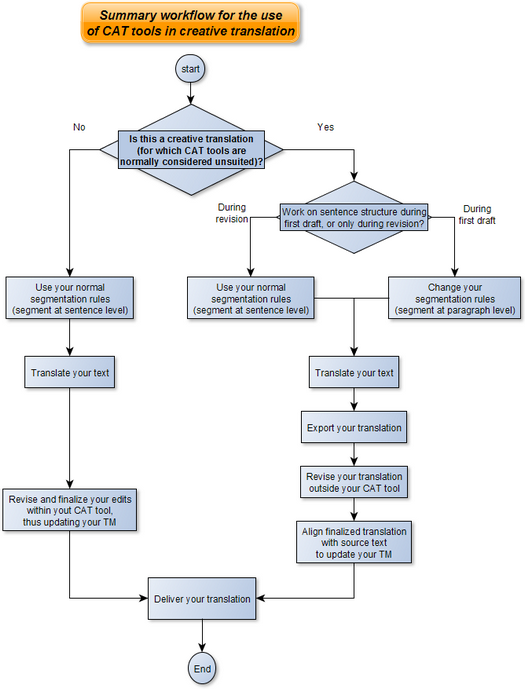 |
| Summary workflow for the use of CAT tools in creative translation |
Bear in mind that while this approach may suit transcreation or creative translation, it is not what works best when dealing with technical translations: it is a technique that helps slow you down, not speed you up. For most freelancers, it would give flexibility with one hand while taking away speed with the other. Besides, in technical, legal and most other commercial translations, preserving a similar structure between source and target is usually a good thing.


