Tuesday, October 24, 2006

Foundations of Translation - Lesson 4

(These are the notes for a course on Foundations of Translation I am teaching at the University College of the University of Denver. I'll be publishing the notes for the various lessons during the next few weeks. A short description of the course can be found here).

Translation in Practice

Translation Process

A - SL writing

B - Translation

  1. Read SL Text
    • Read to understand
    • Identify unknown words/terms
  2. Research terminology
    • Online
    • Reference works
    • Decide on competing usage (Google as large collection of corpora)
  3. Write translation
      Question yourself
    • Am I sure this is the best translation?
    • Does this sound right and familiar only because I always translated it like that?
      Different techniques
    • Use CAT tools
    • Write directly in word processor
    • Overwrite original
    • Write first draft with optional wording, to be self-edited later
        Example:
      • Write first/rough draft using optional/preliminary/candidate terms/words...
  4. Self-edit translation
      Read your translation
    • Does it read like a similar document written by a native speaker of the TL would read?
      If it does not make sense, there is a problem (and "but the original did not make sense, either" or "but I used the same words as the original" are not good excuses)
    • If possible, set it aside after the first draft, to look at it with fresh eyes
    • Send translation to editor

C - Quality Control steps

  • Editing
      Review translation against SL text
    • Errors of meaning
    • Errors of form
    • Errors of compliance
    • Preferential changes
    Different methods
    • Track changes
    • Change translation directly
  • Proofing
    • Review only the TL text (checking the SL
      only if necessary)
  • Other quality control steps (These take place all during the process, from terminology work onwards)
    • Verification that translation is complete (all files translated)
    • Other QC steps

D - QA

Technology, tools, reference materials and publications

Hardware

Computer: PC or Mac?
  • PC environment much more widespread
    • Greater availability of CAT tools
    • Easier to meet customers' requirements
    • Cheaper computers
  • Mac preferable when working with graphic designers
Desktop or laptop?
  • Laptop permits to work anywhere
  • Desktops
    • More powerful
    • Cheaper
    • More robust
Peripherals
  • Scanner (Necessary if much work is received as hardcopy)
  • Printer (Desktop lasers are the most economical choice)
  • External hard disk (For removable back-ups)
  • UPS (Uninterruptible power supply)
Fast Internet connection
  • Essential when working with large files
  • Useful when surfing the web for research purposes

Software

  • Normal software tools (Office software)
    • MS Office
      • Specialized search techniques using wildcards (Regular Expressions)
      • Using Excel to create "ad hoc" translation tools for the translation of software strings (especially when there are size limitations and such)
      • Using Excel to create translation memories from text glossaries
    • Open Office
    • Star Office
  • CAT (Computer-Aided Translation) tools
    • SDL
        Trados
      • Currently the market leader
      • Buggy
      • No free "lite" version
        SDLX
      • "Lite" version available (Works only with projects created by customer)
    • Déjà Vu
    • Omega T
      • Freeware
    • Wordfast
      • Mostly compatible with Trados
      • Cheaper than most other CAT tools
      • Works with the Mac
    • Transit
    • Other translation memory tools
  • Terminology management tools
    • Terminology management tools, such as MultiTerm (SDL)
    • Terminology extraction tools
      • Various different tools to aid in term extraction and terminology management, including expensive Trados and SDL programs
    • Concordancers
  • Additional software tools
    • Localization tools
    • Specialized search tools
    • Adobe Acrobat
      • Professional (Permits editing, annotating, etc.)
      • Reader (Freeware)
    • Text editors
    • DTP programs
      • Framemaker (Text-intensive documents)
      • Quark
      • InDesign
    • HTML editors
      • Front Page
      • DreamWeaver
      • Etc.
    • Graphic editing tools
      • Photoshop
      • Photoshop Elements (Cheaper alternative, permits editing text in Photoshop files)
      • Illustrator
    • OCR (Optical Character Recognition) tools, such as Omnipage (Useful when one receives documents to translate in hardcopy or pdf, and needs to transform them into editable files)
    • Word counting software
    • Translation project management tools (e.g., Translation Office 3000
    • Clipboard utilities (e.g., ClipMate)
    • Screen capture tools (e.g., Gadwin PrintScreen
  • Google and other online search aids
  • MT (Machine Translation)

Reference materials

Assignments for next class

Assignment: read chapters 6 and 7 in "Becoming a Translator", and Chapter 4 of "How To Succeed As A Freelance Translator"

Notes from the previous lessons in this course:

Foundations of Translation - Course Description
Foundations of Translation - Lesson 1: Difference between translation and interpreting
Foundations of Translation - Lesson 2: Jobs for translators
Foundations of Translation - Lesson 3: Characteristics of a good translator

Principles of translation

It is now pretty generally agreed, that translating the writings of the ancients is, if not the sole, at least the plainest, the shortest, and the surest means of becoming well acquainted with them and their language. It is also agreed, that a translation ought exactly to express the original; that it should neither be too free nor to servile; that it should neither deviate into long circumlocutions, which weaken the ideas, nor adhere to strictly to the letter, which debases the sentiment.


(M. Batteux, Principles of Translation, Edimburgh, 1760 - Originally written in French)

This is from a small digitized book you can download for free from Google books.

Wednesday, October 18, 2006

An advertising company gets it: Hispanic Marketing 101

Killian Advertising, a small advertising company from Chicago, has recently posted on their web site a white paper on marketing for the hispanic marker, Just Translate It? Hispanic Marketing 101.

According to Killian, rule number 1 is:
Advertising intended for Hispanic consumers should be written in Spanish, not translated to Spanish from English
By extension, this is true or advertising in other languages as well.

I believe this is substantially right: although it is possible to provide useful translations for advertising, these translations should only be used as a starting point for a good copywriter to re-create and adapt the campaign for the selected target market.

European Commission and universities towards a European Master's in Translation

(From Europa Press releases)

The Directorate-General for Translation of the European Commission will host in Brussels its first conference with universities offering a translation curriculum. They will discuss the development of translator training in the EU, as a first step towards a standard curriculum for a Master's degree in translation within the EU.

Saturday, October 14, 2006

Foundations of Translation - Lesson 3

(These are the notes for a course on Foundations of Translation I am teaching at the University College of the University of Denver. I'll be publishing the notes for the various lessons during the next few weeks. A short description of the course can be found here).

Characteristics of a good translator
Linguistic knowledge

Source language(s) (SL)

Need to understand SL language as well as a native speaker
  • Nuances and subtleties
  • Slang and colloquial expressions
  • Cultural references (Including such things as sports, etc.)
  • Regional variations
  • Different registers
  • etc.

Target language (TL)

  • Native tongue of translator (normally - but see for instance Russian different take on this: emphasis on the need by the translator to fully understand the text)
    In the real world, in several countries, most translators translate by necessity from their native tongue into foreign languages
  • Ability to express oneself eloquently
    • Excellent knowledge of grammar
    • Rich vocabulary
    • Good style
    • An "ear" for one's own language
    • Ability to evolve with the evolving standard of one's language

Subject-matter knowledge

  • The translator needs to understand fully the source language text
  • The translator should have a deep knowledge of the appropriate terminology both in the SL and in the TL
  • Warning: the language component of subject-matter expertise depends also on the language in which such subject matter has been learned

Subject-matter areas

Business
  • Financial statements
  • Web sites
  • Business letters
  • HR material
  • Promotional material
  • etc.
Law
  • Agreements
  • Contracts
  • Certificates
  • Court documents
  • Patents
  • Laws
  • etc.
Industry and technology
  • Computers
    • Software
      • Translation
        • Translation of resource (rc) files
        • Translation directly in the source code
        • Translation of strings extracted to some other format
      • Localization (L10n)
        Localization (sometimes shortened to "l10n") is the process of adapting a product or service to a particular language, culture, and desired local "look-and-feel." An internationalized product or service is therefore easier to localize. In localizing a product, in addition to idiomatic language translation, such details as time zones, money, national holidays, local color sensitivities, product or service names, gender roles, and geographic examples must all be considered. A successfully localized service or product is one that appears to have been developed within the local culture. (From SearchCIO.com)
      • Internationalization (I18n)
        Ideally, a product or service is developed so that localization is relatively easy to achieve - for example, by creating technical illustrations for manuals in which the text can easily be changed to another language and allowing some expansion room for this purpose. This enabling process is termed internationalization. (From SearchCIO.com)
      • Globalization (g11n)
        The process of first enabling a product to be localized and then localizing it for different national audiences is sometimes known as globalization. (From SearchCIO.com)
    • Documentation
      • MS Word files
      • Framemaker
      • Other DTP files (Quark, InDesign, etc.)
    • Help files and web sites
      • HTML
      • DHTML
      • Flash, and other dynamic files
      • XML
      • css and other style files
      • GIF, JPEG and other graphic files
  • Engineering
    • Industrial engineering
    • Plant engineering
    • Civil engineering
    • Examples
      • Railways
      • Steel mills
      • Specifications
      • Instructions
      • etc.
  • Biotechnology
  • etc.
Medicine
  • Medical insurance documents
  • Consent Forms
  • Instructions & Brochures
  • Pharmaceutical documents
  • etc.
Science
  • Astronomy
  • Physics
  • etc.
Social sciences
Arts & humanities
Other...
(Anything under the sun, really)

Professional knowledge

  • Tools available
  • Reference materials available
  • Where to ask for help
  • How to search for the information we need
  • Business knowledge (How to manage one's own job)

Self-knowledge

  • Knowing what one knows and what one does not know, always questioning ourselves
  • Knowing one's abilities, strengths and weaknesses
  • Knowing one's own learning style

Professionalism

  • Accuracy
  • Timeliness
  • Reliability

Assignments for next class

  1. Translate the text selected as part of your Class 2 assignment.
    • Write down the steps followed in creating the translation
    • Write down difficulties encountered and steps taken to overcome them
    • Write how the actual experience differed from your expectations (which you should have written as part of your Class 2 assignment)
    This test will be graded (not on the quality of the translation, but on the work done in externalizing the experience.
    About 250 words each person.
  2. Read chapter in "Becoming a Translator" about the process of translation, and Chapter 3 of "How To Succeed As A Freelance Translator"

Notes from the previous lessons in this course:

Foundations of Translation - Course Description
Foundations of Translation - Lesson 1: Difference between translation and interpreting
Foundations of Translation - Lesson 2: Jobs for translators

Thursday, October 12, 2006

Foundations of Translation - Lesson 2

(These are the notes for a course on Foundations of Translation I am teaching at the University College of the University of Denver. I'll be publishing the notes for the various lessons during the next few weeks. A short description of the course can be found here).

Jobs for translators

Staff-translator

Good place to start

  • Acquires skills while mentored by more experienced colleagues
  • May accrue considerable experience in one (or more) specialistic
    fields
  • At the beginning of one's career, better pay, and better benefits

Needs to be a team player

  • Work well with other people
  • Able to compromise
  • Realize the end product is the team's translation, not an
    individual one

Danger of growing stale

(Not several years of experience, but one year of experience several times over - which is true of other professions, of course)

Free-lance translator

More experience needed

(although many translators start here, with no experience), and needs to be a self-starter

Customers
Translation agencies
  • Wide range of different companies, from concerns where only a very few people work (or even just the principal), through large international companies like SDL or Lionbridge
  • Some companies try to be everything for every customer, other specialize in many different ways
  • Example: our company specializes in providing higher quality services to other translation companies

    See pages 28-30 of "How To Succeed as A Freelance translator"
Direct customers
  • Private individuals (certificates, other documents, usually for consular or similar purposes)
  • Businesses
    • Software companies
    • Law offices
    • Manufacturing companies
    • Etc.

  • Public administration
    • Court system
    • Federal authorities (e.g., Department of State)

    See page 31 of "How To Succeed as A Freelance translator"
Translation rates
How to set one's rates
Various ways of setting one's rates
  • Know what one's overhead is
  • Determine what income one desires
  • See what the market will bear
  • Higher rates for more specialized work
  • Higher rates for higher-quality work (but not everybody really wants that)
See pages 33 and also Chapter 4 of "How To Succeed as A Freelance translator"
Useful links and material about translation rates

Translation editor

  • Task often given to inexperienced translators, should instead be reserved for experienced ones
  • Not every good translator has the skills or mindset for translation editing

Translation project manager

  • Organization
  • Contacts with customers
  • Contacts with vendors
  • Work may be very different in different organizations

Looking for a job as translator

Translation associations, communities and resources

Translation associations

  • Local organizations
    • ATA
      Translation certifications (Usefulness of)
    • CTA

  • Other national and international organizations
    • FIT
      Organization of translation association
    • Organizations in the various foreign countries
      • AITI (Italy)
      • etc.

Translation communities

Payment practice lists

(sites and lists where translators can check on the reputation and payment practices of translation companies)

Translation work

Work management

  • Marketing
  • Time management
  • Project management
    • Recording projects
    • Doing the work
    • Delivery
    • Software for project management
      • Translation Office 3000
      • Ad-hoc software
  • Accounting
    • Receiving orders
      • Purchase orders
      • Contracts
      • Other systems (both more informal or formal)
    • Invoicing
    • Payment reminders
    • Payment collection

Translation workflow

  • SL writing
  • Translation
  • Editing
  • Proofing
  • QA

Assignments for next class

  • Assignment: find a text that you'll translate as part of your Test for
    Class 3 (max 250 words).
    • Select business or technical article to translate (will be translated after 3rd class)
    • Indicate list of reference materials you intend to use to translate the text
    • Write down what difficulties you expect to encounter in translating this materials
    • Have this material ready before 3rd class, but do NOT yet translate the text
  • Assignment: read chapter in "Becoming a Translator" about Learning

Notes from the previous lessons in this course:
Foundations of Translation - Course Description
Foundations of Translation - Lesson 1: Difference between translation and interpreting

Wednesday, October 11, 2006

Microsoft Glossaries RIP

As I mentioned in a previous post, Microsoft has released a new multi-language glossary of about 9000 terms.

Unfortunately, at the same time they have removed the old Microsoft glossaries that have been so useful to many IT translators: the only thing left on the old ftp site is a short readme file, which announces the new glossary as containing "more up-to-date terminology, [...] that is easier to use".

The old material is still available, but only to MSDN subscribers:
  1. Go to http://msdn.microsoft.com/subscriptions/
  2. Use the Sign In button to sign in to your MSDN account.
  3. Click the "Subscriber Downloads and Product Keys" link.
  4. Navigate to Tools, SDKs, and DDKs\Microsoft Glossaries.
I think it is a pity that the old, fuller glossaries are no longer available: it is true that some of the information there had to be taken with a grain of salt, as the glossaries contained many inconsistencies and even errors, but they were not really difficult to use (as Microsoft's readme file implies) - at least for people who knew something about software, or who used some of the various tools available on the web for making full use of the glossaries.

Several people knew about the impending demise of the old glossaries in advance, and I think many made full downloads to save their own copies of the most recent files.

Unfortunately, even those who have backup copies of the old glossaries will have to do without updated copies of the Windows and Office glossaries at the very moment when new and much updated copies of both are on the point of being released.

So no Windows Vista glossary, unless, as I believe, specific terminology information is going to be provided to the companies engaged in the localization of the newer Microsoft products. Even so, translators who would have relied on the updated Microsoft terminology to translate other software products will have to make do without.

Saturday, September 30, 2006

Proof positive that Trados programmers should change job

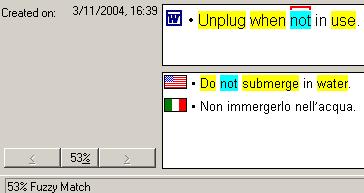
I like to keep the matching settings of Trados fairly low: sometimes that way I get some useful suggestions (especially for long sentences where only part of the sentence matches), but often what I get is something like this:


That's right: "Do not submerge in water" is supposed to be a 53% match for "Unplug when not in use".

Trados' matching algorithms have long been known to be among the poorest of all translation memory tools, but this takes the cake!

Friday, September 29, 2006

Patches for Italian dictionaries on CD-Rom

Some time ago I bought a new computer, but until yesterday I hadn't needed to use any of my dictionaries on CD-Rom on it.
The operating system of the new computer is XP (SP2): of course, none of my dictionaries was running properly.
I knew that in the past I had downloaded the necessary patches and saved them in some backup, but I couldn't find the necessary files, so I had to search them again on the web. Fortunately, they are all still downloadable, and I thought that posting the links to the pages from which the patches can be downloaded might be useful for other colleagues:

Link for Zanichelli dictionaries (Ragazzini, Boch, Zingarelli, Morandini, McGraw Hill Zanichelli, Economics and Business, DELI)

Link for Hoepli dictionaries (Grande Dizionario di Inglese Picchi, Grande Dizionario di Spagnolo di L. Tam, Grande Dizionario Tecnico Francese, Grande Dizionario Tecnico Tedesco, Dizionario Tecnico Inglese Marolli)

Link for Sansoni/Rizzoli dictionaries (Dizionario Tedesco Sansoni, Dizionario Inglese Sansoni - also known as Grande Dizionario Rizzoli-Larousse)

I have personally tested the patches for the Picchi, Tam, Sansoni inglese and McGraw Hill Zanichelli, and they all work - I imagine that the patches for the other dictionaries also should work.

Friday, September 22, 2006

Foundations of Translation - Lesson 1

(These are the notes for a course on Foundations of Translation I am teaching at the University College of the University of Denver. I'll be publishing the notes for the various lessons during the next few weeks. A short description of the course can be found here).

Difference between translation and interpreting

Interpreting

Types of interpreting

Conference interpreting
    Simultaneous
  • First used at the Nuremberg trials
  • Ability to wait for complete sentences, remember them while translating and speaking the previous one
    Consecutive
  • Need to summarize and shorten the oiginal
  • Notes as aid to memory
  • Note-taking techniques (Herbert)
  • NOT: use of shorthand
Business interpreting (Role in business negotiations and meetings)
Community interpreting
  • Court interpreting
  • Medical interpreting

Ethics of interpreting

  • Interpreter as the "voice" of others
  • Interpreter as cultural bridge

Translation

University degrees for translators

Usefulness of university degree in translation (Respect accorded to degrees in translation from the major translation schools)
University-level degrees in translation
    USA
  • MIIS
    Most prestigious / Oldest program in the USA
  • Kent
    Important center for Terminology studies
    Europe
  • Geneva
    One of the best programs in Europe
  • Trieste
    My "Alma Mater", first school in Italy, excellent
    Other (beware of the quality of many non university-level courses)

Books and publications on translation

    Books for course
  • McKay, Corinne: How to Succeed as a Freelance Translator, 2 Rat Press, 2006
  • Robinson, Douglas: Becoming a Translator, Routledge, 1997, 2003 (2nd ed.)
    Other interesting and useful books
  • Baker, Mona: In Other Words, Routledge, 1992
  • Hofstadter, Douglas R.: Le Ton beau de Marot , Basic Books, 1997
  • Chesterman, Andrew: Memes of Translation, Benjamins, 1997
  • Chesterman, Andrew and Wagner, Emma: Can Theory Help Translators?, St. Jerome, 2002
    Other publications
  • ATA Chronicle
  • Multilingual

Allied subjects

Translation quality control activities

  • Revision
  • Reviewing
  • Editing
  • Proofreading

Localization

Terminology management

  • Terminology extraction
  • Glossary creation

Translation studies (Theoretical discipline)

Media activities

  • Sub-titling
  • Voice-over

Technical writing

Copywriting