Mats Linder's SDL Trados Studio - The Manual has now been updated with a new edition - the second for SDL Trados Studio 2019, to cover changes introduced with service release 1 (SR1) of the program.
The manual is now grown to 598 pages, and includes 30 pages on machine translation -- useful for many translators, considering the ever-increasing presence of MT in many projects.
The price is USD 52 or 49 Euro for new users (or half of that for those who bought previous versions of the manual).
I highly recommend it, since it complements (and mostly supersedes) SDL's own badly written documentation: Mats writes in a way that any user of SDL Trados studio will find useful.

Showing posts with label Books. Show all posts
Showing posts with label Books. Show all posts
Tuesday, May 21, 2019


Tuesday, April 09, 2019
'It's a silent conversation': authors and translators on their unique relationship
From the Guardian, an interesting article on authors and their translators:
From Man Booker International winner Olga Tokarczuk to partners Ma Jian and Flora Drew … leading authors and translators discuss the highs and lows of cross-cultural collaboration.
From Man Booker International winner Olga Tokarczuk to partners Ma Jian and Flora Drew … leading authors and translators discuss the highs and lows of cross-cultural collaboration.
Monday, October 01, 2018
SDL Trados Studio Manual 2019 - Just Published
Mats Linder has been publishing (and regularly updating) his "SDL Trados Studio Manual" for many years now, thus providing an indispensable service to all users of SDL Trados Studio, who otherwise would be left at the mercy of SDL's own obscure documentation.
He has just released the newest version of the manual SDL Trados Studio Manual 2019, updated to cover the most recent version of the program from SDL.
The new version of the manual describes what's new in Studio 2019, as well as the features offered by new plugins released in SDL's app store since the previous version of the manual. 573 pages.
He has just released the newest version of the manual SDL Trados Studio Manual 2019, updated to cover the most recent version of the program from SDL.
 |
| SDL Trados Studio 2019 Manual cover |
Tuesday, November 24, 2015
Three technical manuals for translators
Three books I highly recommend to translators interested in improving their technical skills:
- Software for translators, in general
The Translator's Tool Box: A Computer Primer for Translators, Version 12
by Jost Zetsche.
A wide ranging introduction to a number of different software programs used by translators, written by a veritable guru of translation tools. - memoQ
New beginnings with MemoQ
by Kevin Lossner and Cátea Caleço Murta.
A good and thorough tutorial on memoQ, written by a real expert on the program. - SDL Trados Studio
SDL Trados Studio 2015 - The Manual
by Mats Linder.
Mats has been writing an independent manual for Studio since version 2011 of the program. An absolute must for all users of the Studio.
Tuesday, September 08, 2015
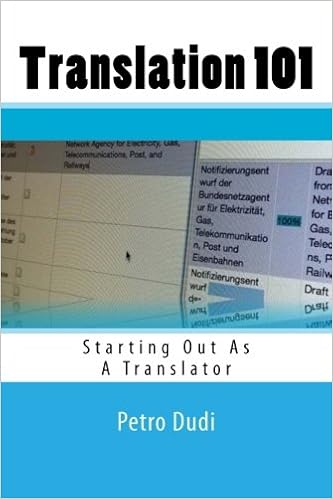
Translation 101: Starting Out As A Translator
The number of handbooks aimed at beginning or more seasoned translators is growing. A recent addition is Translation 101: Starting Out as a Translator, by Petro Dudi.

I haven't had the time to read the whole book yet, but it should prove useful, especially to beginning translators.
If you are interested in the eBook alone, probably the cheapest price is through Amazon (or another webstore, like Lulu) - but if you want an unlocked version of the book, in three different formats (pdf, eBook and Mobi), and three additional spreadsheet tools, then go through the author's own website.
I haven't had the time to read the whole book yet, but it should prove useful, especially to beginning translators.
If you are interested in the eBook alone, probably the cheapest price is through Amazon (or another webstore, like Lulu) - but if you want an unlocked version of the book, in three different formats (pdf, eBook and Mobi), and three additional spreadsheet tools, then go through the author's own website.
Saturday, August 22, 2015
For the first time ever, a translated novel wins the Hugo Award
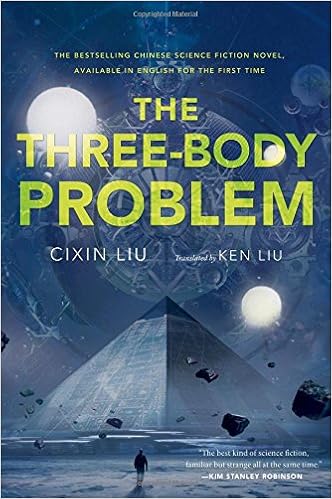
"The Three Body Problem" has won the 2015 Hugo Award for best novel.
This is the first time that the prize has been given to a translated work. Congratulations to Cixin Liu, the novel's author, and to Ken Liu, its translator. Congratulations also to the publisher, for doing the right thing and prominently displaying the translator's name alongside the author's, on the cover of the book:

This is the first time that the prize has been given to a translated work. Congratulations to Cixin Liu, the novel's author, and to Ken Liu, its translator. Congratulations also to the publisher, for doing the right thing and prominently displaying the translator's name alongside the author's, on the cover of the book:
Thursday, May 22, 2014
Update: Role of Translation in Nation Building now available also as an eBook
Role of Translation in Nation Building (see my previous post about this book), a book edited by Ravi Kumar, the President of the Indian Translators Association, is now also available in eBook format.
If you are interested, you can use this link to go to the Hind Center web page. There you can purchase the book or find more information about it.
If you are interested, you can use this link to go to the Hind Center web page. There you can purchase the book or find more information about it.
Saturday, March 23, 2013
New book: "Role of Translation in Nation Building"
The book has been jointly published by Modlingua and the Indian Translators Association.
The book talks about how translators have always played a pivotal role in social and cultural change in society and how they continue to play a major role in dissemination of the ever expanding knowledge and information available today. In this globalized world the demand for translation and language related services has increased many times and that translation is not only needed for the creation of national identity but it has also become an essential tool for keeping pace with the processes of globalization and localization. Many times we take for granted the translator's crucial role at the (intra) national level and we are less aware of their equally pivotal place as mediators at the international level and, potentially, in the creation of the even larger and comprehensive global supra national identities which seem destined to follow in the future.
The book also covers how translation has played crucial role in shaping up nations not only in Indian/Asian context but also in the context of Europe, Canada, Africa, Australia and Arab world. Hence, in a way, the extent/range of thoughts/issues discussed in the book, encompass the entire globe. The book is also an attempt to find answers to issues like:
- What role has translation played in Nation Building in the Indian as well as global context?
- How easy or difficult is it to view Translation and Nation Building as a well-gelling couple?
- Did translation play a role in Turkish modernism movements and its accession to European Union?
- What about Translation and Nation Building in the African, Arabian and Australian contexts?
- Do national conflicts and language politics actually impact literary works and translations?
- How can media play an effective part in bringing social changes by means of translations?
- How has translation impacted the discourse on nationalism and globalization in the Arab World?
The book can be utilized as a guiding base/reference tool/textbook by:
- Students of language learning and its theory; translation studies; literature.
- Research scholars working in areas related to translation, nationalism, globalization, international studies, etc.
- Professors, teachers involved in teaching the above mentioned subjects/topics.
Digital as well as Printed version available at Modlingua, K-5B, Lower Ground Floor, Kalkaji, New Delhi -110019
SMS: +91-8287636881 E-mail: sales@modlingua.com
ISBN Printed Version: 978-81-926798-0-8; ISBN Digital Version: 978-81-926798-1-5. Price within India INR 395, outside India US $ 24.95. Payment option available through Paypal. Contact:
Modlingua Learning
K-5B, Lower Ground Floor
Kalkaji, New Delhi -110019
Web: www.modlingua.comSMS: +91-8287636881 Skype: ravikumar.net
Facebook Link: https://www.facebook.com/modlingua

Thursday, December 06, 2012
Mox II
Many translators already know (and identify with) Alejandro Moreno-Ramos's downtrodden translator, Mox.
Last year Alejandro published Mox Illustrated Guide to Freelance Translation, with articles from several prominent translators and over two hundred cartoons, many never published on his blog before.
Now he has done it again with his second book: Mox II - What they don't tell you about translation, which has been published today - a perfect gift for other translators (or for yourself).

As in the first book, the adventures of Mox, Calvo, and the other characters in the strip are accompanied by a series of articles from prominent translators - and this year I had the honor of being invited to contribute one of of the articles. With Alejandro's permission I'm republishing my article (it will be in my next post) - but I urge you to order the book so you enjoy the other articles and the new cartoons.
Tuesday, November 29, 2011
Letters of Blood, by Göran Printz-Påhlson
Open Book Publishers has recently announced the forthcoming publication of Letters of Blood and other English Works. The book contains the English translations of selected poems by the major Swedish modernist poet and critic Göran Printz-Påhlson. As well as Letters of Blood, the collection includes the full text of his statement "The Words of the Tribe".
Göran Printz-Påhlson died in 2006. He was a critic, a poet, and a translator (he translated American, Irish and English poets into Swedish, and Swedish poets into English).
Open Book Publishers is an open-access non-profit publisher specializing in the Humanities and Social Sciences. They publish their books in paperback, hardback and digital format (pdf, epub, mobi), and include the full versions of all titles for free reading on Google Books.
Sunday, June 12, 2011
Denver Public Library v. foreign language readers
We are just back in Denver, in time for a weekend that included the Denver Public Library’s annual book sale.We normally enjoy the book sale: a chance to contribute to the library and, at the same time, find some interesting books.
There was an unusual quantity of foreign language books this year, including many Italian ones. Unlike last year, when the Italian books available mostly came from a couple of private donors, this year all of the books came from the library’s own shelves.
I had a bad feeling about that: I thought the library had decided to reduce its Italian collection. I asked a librarian, but it was even worse than I thought: the Denver Public Library has decided to get rid of most foreign language collections in their entirety.
Considering the painful cost-cutting measures the library has to implement (including the planned closure of up to half its branches) I could understand a decision not to purchase foreign language books any longer. But why not keep those they already had, at least until they were in fit conditions for borrowing (and the stamps on the books clearly showed most of them had been borrowed many times from the library)?
So, if you want to read Petrarca, Dante, Goldoni, Calvino, Pavese or Levi in the original, you are out of luck at the Denver Public Library.
Thursday, April 22, 2010
New book on the business of freelance translation
Judy and Dagmar Jenner have just published “The Entrepreneurial Linguist: The Business-School Approach to Freelance Translation”.
Judy gave a presentation on her “business-school approach” to freelancing some time ago, at a CTA session, and I was impressed how helpful her approach was. The book is available both as a paperback and as a downloadable e-book. I just ordered my copy, and plan to review the book here, as soon as I have a chance to read it.
Congratulations to Judy and Dagmar!
Wednesday, February 10, 2010
Who really wrote those words?
I'm reading "Writing Tools, 50 essential strategies for every writer", by Roy Peter Clark. Instead of rules to follow, his book provides tools to exploit (although many of the tools sound quite similar to the rules provided by other books on writing).
Each tool has its own chapter, and each chapter gives practical examples from many different authors, including some foreign writers. For instance, in his chapter on ordering words for emphasis, Clark quotes the famous opening of Cien años de soledad: "Muchos años después, frente al pelotón de fusilamento, el Coronel Aureliano Buendía había de recordar aquella tarde remota en que su padre lo llevó a conocer el hielo."
But Clark quotes this in English: "Many years later, as he faced the firing squad, Colonel Aureliano Buendía was to remember that distant afternoon when his father took him to discover ice." Yet, in providing an example about words and their placement for emphasis, Clark attributes them to Gabriel García Márquez, alone, not also to Gregory Rabassa.
If these words serve as an example in a book in English about writing, Clarke should have mentioned that who chose them in English (and not others that might have legitimately been used), was Rabassa, the translator, not Márquez, the original author.
This is "the translator's invisibility", according to both meanings Lawrence Venuti gives to the term.
As translators, we lend our pens and words to others, and let them make them their own... unless we blunder: when we choose well, transform powerful source into spellbinding target, the translator's words become the original author's own. But if we fail in our choice of words, then the failure is ours: it's only then that we become visible.
Each tool has its own chapter, and each chapter gives practical examples from many different authors, including some foreign writers. For instance, in his chapter on ordering words for emphasis, Clark quotes the famous opening of Cien años de soledad: "Muchos años después, frente al pelotón de fusilamento, el Coronel Aureliano Buendía había de recordar aquella tarde remota en que su padre lo llevó a conocer el hielo."
But Clark quotes this in English: "Many years later, as he faced the firing squad, Colonel Aureliano Buendía was to remember that distant afternoon when his father took him to discover ice." Yet, in providing an example about words and their placement for emphasis, Clark attributes them to Gabriel García Márquez, alone, not also to Gregory Rabassa.
If these words serve as an example in a book in English about writing, Clarke should have mentioned that who chose them in English (and not others that might have legitimately been used), was Rabassa, the translator, not Márquez, the original author.
This is "the translator's invisibility", according to both meanings Lawrence Venuti gives to the term.
As translators, we lend our pens and words to others, and let them make them their own... unless we blunder: when we choose well, transform powerful source into spellbinding target, the translator's words become the original author's own. But if we fail in our choice of words, then the failure is ours: it's only then that we become visible.
Sunday, April 12, 2009
Book Review: Booher's Rules of Business Grammar
Shortly after posting my review of Luca Serianni's "Prima lezione di grammatica", I received a message asking whether I would like to get a copy of a new grammar self-help book: Dianna Booher's "Booher's Rules of Business Grammar: 101 Fast and Easy Ways to Correct the Most Common Errors". I said I was interested; a few days later I received the book. After several weeks, here is my review.
I admit I have not read the book from the first to the last page, but only looked at the issues that most interested me. I believe it is designed to be skimmed until you find one or more sections that deal with your linguistic doubts.
The books briefly explains the underlying grammar, suggests the correct way to write something, says what is wrong with the alternatives, and provides mnemonic help to remember the correct solution for each error.
The target audience is not clear: some of the errors corrected are the kind that normally only native speakers of English make (such as the contraction "it's" wrongly used for the possessive "its": a blunder sometimes committed by native speakers but which I have never seen in the writing of educated foreigners). Other errors only foreigners - without an instinctive ear for English as their native tongue - would make (such as "They had went to the office earlier in the day").
Some of the chapters are certainly useful. For example, one doubt I sometimes have is the difference in usage between "may" and "might". The book's explanation is clear
May means that things are possible, even likely. Might means that there's less likelihood of something happening. [...] Might is also the past tense of may. In those situations, the degree of possibility is not the criterion for using might. If the other verbs in the sentence are past tense, may becomes might (past tense).
although in this case at least, the mnemonic suggested is obscure:
Link the may-might dilemma to Dusty Springfield's hit ["just wishin' and hopin'"], and you'll be humming the criterion for choosing the correct word: What's the likelihood? May implies that things are more likely than might does.
Not useful to those who don't know Dusty Springfield is or was, and have no idea what's the tune we are supposed to be humming to remember the mnemonic by.
Other chapters fare less well. For example, the section on the difference between "lie" and "lay" tries to give a useful table to clarify the differences, but then botches the grammatical terminology in the table:
Verb: to tell a falsehood [...]

Past                lied   Mortimer lied yesterday

Present participle  lied   Mortimer has lied on numerous
                           occasions

Verb: to recline [...]

Past                lay    The unsigned check lay on his
                           desk for a week

Present participle  lying  Eldora is lying down for a nap
                           every day after her chemo treatments
"Has lied", is not a present participle, but a present perfect. An example with a present participle could have been "Mortimer told the truth yesterday, but he is lying now".
The lack of parallelism in the examples ends up confusing the issue: "lie" in the sense of "to tell a falsehood" has examples for the present tense, the past, the present perfect (wrongly called present participle), and the past participle, but no example for the present participle; in the sense of "to recline" it has examples for the present tense, the past, the present participle, and the past participle, but no example for the present perfect. A few lines further on, "laid" is also called the present participle of the verb "to lay" ("They have laid walkways around the building this week"). Again, "have laid" is not the present participle, but the present perfect.
The book is inexpensive (the cover price is $ 16.95), and could be useful for foreigners (for example professionals) who need to write English as their second or third language. For translators whose native tongue is English the book will probably be of little help, since they should already know their own tongue much better than this. I also think it won't be very useful for translators who habitually write in English, even when English is not their native tongue, if they have a good grounding in English grammar.
Many of the mnemonics will be useful for part of the book's audience (at least for the readers who rely more on aural than on visual memory).
In the companion web site you can answer 25 questions to "test your grammar IQ". It's a nice touch, and can help you see whether reading the book has helped you any (by taking the test before and after). The test gives a score but it does not suggest which answers were wrong, nor what the correct answers should have been. I think this omission should be corrected in a way that could entice more readers: something like "you answered x to question 24, but the correct answer is y. To see why this is the correct answer and x was wrong, and to find more help for your linguistic doubts, please see our book".
To sum up: a book that may be helpful to some, especially to foreigners writing in English, but not to most translators.
Sunday, February 22, 2009
Keeping our grammar current: Serianni's "Prima lezione di grammatica"
Most translators have studied the grammar of several different languages. Paradoxically, sometimes we are most out of date with the grammar of our own native language.
We studied it first in elementary school. Again in middle school - but usually skipping what we learned in the earlier grades. By high school, often we were done with grammar, shifting our attention to other linguistic subjects. Unless we continued specializing in our own language at university (perhaps studying to become a teacher), most of us never studied our own grammar again.
Meanwhile we studied the grammar of a foreign language (or more than one). As we studied it later than our own, this knowledge is likely fresher.
Without a conscious effort to keep current formal knowledge of our native language, we increasingly recall grammar notions through the fog of imperfect memory. We should not rely on the grammar book used when we were in grade school, either: grammatical knowledge and consensus change. We should learn what is newly acceptable, what was correct even if our primary school teacher said otherwise forty years ago, and maybe also the rule he clearly explained to the class - but that day we were too busy looking out of the window, and didn't pay attention.
There are plenty of good works available for the Italian translator who wishes to brush up old studies or keep current with new notions.
An excellent little book I've recently read is Luca Serianni's "Prima lezione di grammatica". Although not a comprehensive grammar (such as Serianni's own excellent "Grammatica italiana"), it analyses topics likely to interest the Italian translator, from the plural of unassimilated foreign words ("molti flash" or "molti flashes"?), to problems of coherence and cohesion, and of grammatical accord of number and gender in writing.
The book is well written, but demands some effort - Serianni uses technical terms as necessary, and I had to look some of them up. Some I didn't know, and some I only half recalled from studying grammar so long ago.
Recommended to all Italian translators!
We studied it first in elementary school. Again in middle school - but usually skipping what we learned in the earlier grades. By high school, often we were done with grammar, shifting our attention to other linguistic subjects. Unless we continued specializing in our own language at university (perhaps studying to become a teacher), most of us never studied our own grammar again.
Meanwhile we studied the grammar of a foreign language (or more than one). As we studied it later than our own, this knowledge is likely fresher.
Without a conscious effort to keep current formal knowledge of our native language, we increasingly recall grammar notions through the fog of imperfect memory. We should not rely on the grammar book used when we were in grade school, either: grammatical knowledge and consensus change. We should learn what is newly acceptable, what was correct even if our primary school teacher said otherwise forty years ago, and maybe also the rule he clearly explained to the class - but that day we were too busy looking out of the window, and didn't pay attention.
There are plenty of good works available for the Italian translator who wishes to brush up old studies or keep current with new notions.
An excellent little book I've recently read is Luca Serianni's "Prima lezione di grammatica". Although not a comprehensive grammar (such as Serianni's own excellent "Grammatica italiana"), it analyses topics likely to interest the Italian translator, from the plural of unassimilated foreign words ("molti flash" or "molti flashes"?), to problems of coherence and cohesion, and of grammatical accord of number and gender in writing.
The book is well written, but demands some effort - Serianni uses technical terms as necessary, and I had to look some of them up. Some I didn't know, and some I only half recalled from studying grammar so long ago.
Recommended to all Italian translators!
Monday, January 12, 2009
Should the translator contact the author?
Should the translator contact the author, and if so, how much weight should the translator give to the author's overt intention as against his or her intentions as perceived or inferred from the text of the book?
[...] the translator also has to decide whether to be loyal to an author’s perceived intent or to the inner workings of the actual textA very interesting post by A.M. Correa in the Words Without Borders blog.
I so wish I could do that
Reading 462 books a year.
Brings to mind a passage in Chaim Potok's The Chosen, where Reuven more or less tells Danny to knock it off, because if Danny was reading ten books a week, Reuven himself was not far behind, at seven or eight.
The best I ever managed was slightly over 160 in a year, when I was in college, and nowadays I'm lucky if I break 50 or so.
Sigh.
Brings to mind a passage in Chaim Potok's The Chosen, where Reuven more or less tells Danny to knock it off, because if Danny was reading ten books a week, Reuven himself was not far behind, at seven or eight.
The best I ever managed was slightly over 160 in a year, when I was in college, and nowadays I'm lucky if I break 50 or so.
Sigh.
Friday, February 22, 2008
English-Italian dictionaries: CD-ROMs and online
I believe that most, if not all, major EN>IT IT>EN dictionaries are now available on CD-ROM or at least with CD-ROM available (in addition to the paper dictionary).
I don't have a link for the Ragazzini (Zanichelli), but the Picchi (Hoepli), Rizzoli-Larousse "Sansoni" (which, sadly, does not contain the full text of the great Sansoni-Macchi), and Hazon-Garzanti are now available online.
Of the above, I think the best and most complete general English-Italian dictionary nowadays is Picchi's, closely followed by Rizzoli-Sansoni.
You can try them for yourself, using the following links:
- Picchi-Hoepli (register at the site: the dictionary is available even without registration, but only in abbreviated form)
- Rizzoli-Sansoni (the link I provide is to a page on our company's web site: you can obtain the code to add them to your own web page by following this link)
- Hazon-Garzanti.
- Oxford Paravia Concise
- Collins
Using these dictionaries "for free" online is tempting, and occasionally useful. Remember, however, that the CD-ROM versions have some important advantages: faster searches, availability even when you are not online, and additional functionality, (much richer search capability, from full-text searches to the use of boolean operators).
Update
I've added to the body of this post another two online dictionaries, Oxford-Paravia Concise and Collins, which have been suggested by colleagues.
I will probably write a comparison review of these online dictionaries in a future post.
Wednesday, June 14, 2006
New Book: How to Succeed as a Freelance Translator
Boulder-based freelance translator Corinne McKay has just published "How to Succeed as a Freelance Translator," a book for people who want to become translators.
According to this press release, this "is the book that author [...] Corinne McKay wishes she could have read when she launched her freelance translation business".
I've not read the book, yet, but from the description it might be useful for people starting out in our profession.
According to this press release, this "is the book that author [...] Corinne McKay wishes she could have read when she launched her freelance translation business".
I've not read the book, yet, but from the description it might be useful for people starting out in our profession.
Wednesday, May 03, 2006
New Version of Translator's Tool Box
The Translator's Tool Box is an e-book aimed at professional translators. It contains a wealth of information about software useful to translators: from useful information on how to use various features of the operating system and of Office application to a discussion of CAT tools and to information on more specialized "little" utilities such as Search & Replace or Clipmate, and much more.
We have just received the fourth edition, which adds information on how to translate complex file formats (such as XML).
Highly recommended.
We have just received the fourth edition, which adds information on how to translate complex file formats (such as XML).
Highly recommended.
Subscribe to:
Posts (Atom)