Yesterday, at the 9th annual conference of the Colorado Translators Association, I gave a new presentation: "Term Extraction Using Concordance Tools". I think it was well received: lots of colleagues attended, and several had various questions to ask at the end.
I've posted the presentation (in embedded form) in the "Other Presentations" tab of this blog, from which you can also download a copy. At the end off the presentation there are links to all the programs mentioned.

Showing posts with label CTA. Show all posts
Showing posts with label CTA. Show all posts
Sunday, April 28, 2019


Wednesday, April 27, 2016
6th Annual Conference of the Colorado Translators Association
Last weekend we attended the 6th Annual Conference of the Colorado Translators Association. I enjoyed the conference: all the sessions I went to were interesting, useful, and well presented. I saw again friends and colleagues I’ve known for years, and met new people. Two of my current students were at the conference; I think they found it worthwhile. I also saw students from earlier courses, now well launched on their translation careers.
Three interesting books were on sale at the conference: Eve Lindemuth Bodeux’s Maintaining Your Second Language (“practical and productive strategies for translators, teachers, interpreters and other language lovers”); Tess Whitty’s The Marketing Cookbook for Translators (“foolproof recipes for a thriving freelancer career”); and the 3rd edition of Corinne McKay’s How to Succeed as a Freelance Translator.
The first session we attended on Saturday was “Future-Proofing Your Translation Business”, the keynote on marketing given by Tess Whitty on strategies for a thriving career as a freelancer. Tess spoke of protecting and improving our business assets (especially our translation skills), investing in continuing education, time management, mind-sets to avoid (for example atelophobia, the fear of not being good enough), and goal settings: 95% of people don’t write down the goals they set for themselves. The remaining 5% are those who do reach their goals.
The second session was “Inside the Mind of a Project Manager: Common Questions and Concerns”, a presentation on how to work better with beleaguered project managers, delivered with verve by Andie Ho. Andie spoke of the care and feed of PMs (i.e., how to keep them happy). She mentioned such common-sense things as making sure we keep communication channels open, being honest about our abilities, and not being afraid of asking intelligent questions. No platitudes such as “there is no such a thing as a dumb question” from Andie: her rule of thumb is that if you can find the answer within two minutes with a simple Google search, then, yes, the question was dumb and wasted the PM’s time. Final thoughts from Andie’s presentation: “PM are not out there to get you—are you out to get your PM?”
The next presentation was “Creating a Compatible Customer Base within the Language Services Industry”, by Karen Tkaczyk, on how to get a better class of clients. The main takeaway for everyone here was that the “ideal customer” doesn’t exist, and that we should aim instead at assembling an ideal basket of good customers.
“Automating Termbase Creation”, by Sameh Ragab (who came to Boulder all the way from Egypt just for the conference), was a must-go presentation for anyone interested in translation tools. Sameh answered the question “Why is terminology important?” by saying that good terminology helps make our translations more clear, consistent and easier to review, thus achieving faster turnaround. Good terminology increases brand value, both for clients and for us. I’m looking forward to reading Sameh’s presentation on the CTA’s website: he promised he would include references to all the enticing programs he described.
Our last presentation on Saturday was “Vetting Clients—How to Use Payment Practices and Other Sources to Prevent Late or Non-Payment”, by Ted Wozniak: a good description of how to use Ted’s Payment Practices site (and other resources) to avoid poor payers.
On Sunday we took part in two workshops: “Create Focus and Simplify Your Marketing Efforts with a Marketing Plan for Your Translation Business”, by Tess Whitty, and “It’s All About Style: Creating Consistent Documents for Clients” on how to create a style sheet to improve consistency, by Alice Levine. This session on creating a style sheet was an eye-opener, for me: I didn’t know that the best way to create a style sheet is not while translating, writing, or editing, but as a separate step, when all your attention goes to deciding what should go on the style sheet. After the exercises we did during the workshop, now I see why: it’s important, and deserves full, undivided concentration.
The setting, once again at the National Center for Atmospheric Research in the foothills above Boulder, contributed stunning views and a beautiful mountain environment just outside the conference.
Thank you to the CTA’s organizing committee for a job well done!
P.S. I haven't mentioned the presentations that I didn't get to, but if anybody who has attended them would like to send me a brief recap of what was said there, I'd be happy to add to this post.
Three interesting books were on sale at the conference: Eve Lindemuth Bodeux’s Maintaining Your Second Language (“practical and productive strategies for translators, teachers, interpreters and other language lovers”); Tess Whitty’s The Marketing Cookbook for Translators (“foolproof recipes for a thriving freelancer career”); and the 3rd edition of Corinne McKay’s How to Succeed as a Freelance Translator.
 |
| Eve, Tess and Corinne with their books |
The second session was “Inside the Mind of a Project Manager: Common Questions and Concerns”, a presentation on how to work better with beleaguered project managers, delivered with verve by Andie Ho. Andie spoke of the care and feed of PMs (i.e., how to keep them happy). She mentioned such common-sense things as making sure we keep communication channels open, being honest about our abilities, and not being afraid of asking intelligent questions. No platitudes such as “there is no such a thing as a dumb question” from Andie: her rule of thumb is that if you can find the answer within two minutes with a simple Google search, then, yes, the question was dumb and wasted the PM’s time. Final thoughts from Andie’s presentation: “PM are not out there to get you—are you out to get your PM?”
The next presentation was “Creating a Compatible Customer Base within the Language Services Industry”, by Karen Tkaczyk, on how to get a better class of clients. The main takeaway for everyone here was that the “ideal customer” doesn’t exist, and that we should aim instead at assembling an ideal basket of good customers.
“Automating Termbase Creation”, by Sameh Ragab (who came to Boulder all the way from Egypt just for the conference), was a must-go presentation for anyone interested in translation tools. Sameh answered the question “Why is terminology important?” by saying that good terminology helps make our translations more clear, consistent and easier to review, thus achieving faster turnaround. Good terminology increases brand value, both for clients and for us. I’m looking forward to reading Sameh’s presentation on the CTA’s website: he promised he would include references to all the enticing programs he described.
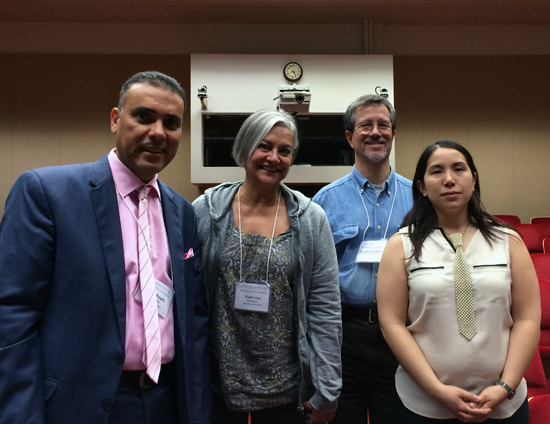 |
| Sameh Ragab, outgoing CTA President Thaïs Lips, myself and Andie Ho |
On Sunday we took part in two workshops: “Create Focus and Simplify Your Marketing Efforts with a Marketing Plan for Your Translation Business”, by Tess Whitty, and “It’s All About Style: Creating Consistent Documents for Clients” on how to create a style sheet to improve consistency, by Alice Levine. This session on creating a style sheet was an eye-opener, for me: I didn’t know that the best way to create a style sheet is not while translating, writing, or editing, but as a separate step, when all your attention goes to deciding what should go on the style sheet. After the exercises we did during the workshop, now I see why: it’s important, and deserves full, undivided concentration.
The setting, once again at the National Center for Atmospheric Research in the foothills above Boulder, contributed stunning views and a beautiful mountain environment just outside the conference.
 |
| Sketch of NCAR from afar |
P.S. I haven't mentioned the presentations that I didn't get to, but if anybody who has attended them would like to send me a brief recap of what was said there, I'd be happy to add to this post.
Thursday, May 28, 2015
New version of my Xbench presentation now available for viewing and download
I've just uploaded the new version of my Xbench presentation, now updated with all the changes I made to it for the workshop I gave at the 5th CTA Conference, earlier this month.
You can view a copy of the presentation as an online presentation by going to the Xbench page of this blog, or you can download a zipped copy of the presentation, from the same page.
Monday, August 18, 2014
An interview on the CTA website
Marion Rhodes, CTA Social Media Coordinator, interviewed me for the Colorado Translators Association website... and now the interview has been published:
Imagine translating without the help of the Internet – or the computer for that matter. The tools that have become indispensable to today’s translators haven’t been around all that long. Today, we talk to a translator who has witnessed the changes in our industry over the past three decades: Riccardo Schiaffino, an ATA-certified English into Italian technical translator and president of Aliquantum, Inc., in Denver.You can read the interview by following this link.
Friday, May 03, 2013
Note-Taking for Translators
Tomorrow (Saturday) is the 3rd Annual Conference of the Colorado Translators Association.
I'll be giving a presentation on "Note-Taking for Translators and Translation Editors".
I've added a page to this blog with links to the presentation in Power Point and pdf formats.
I'll be giving a presentation on "Note-Taking for Translators and Translation Editors".
I've added a page to this blog with links to the presentation in Power Point and pdf formats.
Wednesday, September 21, 2011
Introduction to SDL Trados Studio
On Saturday, October 8, from 1:30 to 4:30 PM, at the Westminster College Hill library, the Colorado Translators Association will offer an SDL Trados Studio training session. The four of us who are going to present met yesterday in a very productive planning discussion. We have a very information-packed outline, and are now busy working on the actual presentations.
This three-hour session is meant for users of all levels, provided they have a basic understanding of what a translation memory is. We'll be looking at the translation workflow in Studio 2009: learn how to prepare files for translation, how to upgrade memories, how to create simple and complex projects, how to set up profiles, how to translate and edit and (the icing on the cake) we also will see how to use some useful features such as QA, Autotext and Autosuggest. Finally, we'll get a glimpse into the future, with some of the new features in the upcoming Studio 2011. The presenters will be CTA members Anna Kuzminsky, Anouschka Zecha, Riccardo Schiaffino and Margherita De Togni.Registration is already open (see http://cta-web.org/upcoming-events for details). We have space for 20 people and are anticipating this session will sell out, so if you are paying by check, please e-mail Corinne McKay at corinne@translatewrite.com to let her know that your check is on the way.
Cost: $40 for CTA members, $50 for non-members, limited to 20 participants.
Sunday, May 15, 2011
Trados 2007 v. Studio 2009, warts and all
Yesterday, my partner Margherita De Togni and I gave a presentation at the 2011 Colorado Translators Association Mid-Year Conference: “Trados 2007 and SDL Trados 2009: Warts and all”. The presentation examined ten defects of Trados 2007 (“classic” Trados) to see if things had been improved in Studio 2009.
The answer, for us, is a qualified pass for Studio 2009 – we find it a better CAT tools than the old version, with some really useful improvements (such as the filter bar and the concordance search on the target text as well as on the source). Some of the most frustrating issue with the MS Word/Trados combo are no longer an issue (messed-up formatting, skipping the text in tables or text boxes), some, unfortunately, are still there (unprotected URLs presented as editable text, poor fuzzy matching algorithms).
For many, of course, the most glaring defect in Studio 2009 is the program’s inability to handle legacy bilingual Trados/MS Word (.doc) files - but there are rumors that this is going to be addressed in the next major release of the tool.
If you would like to see or download a pdf file with the slides from our presentation, please click here (or the presentation title above); for details on the URL problem, see: “Trados: beware of wrong links”; for more on the fuzzy match problems, see the following posts: “One reason I believe the sooner Trados disappears, the better...”, “Proof positive that Trados programmers should change job”, “Shouldn't Trados programmers improve their matching algorithms?”, “Yet again: Trados fuzzy match woes”, and “Yet again: Trados fuzzy match woes (Expanded)”.
Friday, May 13, 2011
2011 Conference | Colorado Translators Association
We'll be in Boulder this weekend for the first ever Colorado Translators Association mid-year conference. Corinne and the organizing committee have done a great job of promoting the conference and selecting interesting presentation (maybe I shouldn't say so, since one of them is our own presentation on Trados 2007 v. 2009).
The conference will be complemented on Sunday by ATA certification exams, and by two Trados training sessions.
After the conference, I'll post the slides from our presentation here in About Translation.
Friday, February 25, 2011
Xbench presentation
Yesterday I gave a presentation to the Colorado Translators Association on Xbench, ApSIC’s excellent terminology management and translation QA freeware tool.
You can download the presentation from the Xbench Training tab of this blog.
To download the tool itself, just go to ApSIC’s webiste
You can download the presentation from the Xbench Training tab of this blog.
To download the tool itself, just go to ApSIC’s webiste
Wednesday, February 16, 2011
Forthcoming XBench presentation
Thursday, February 24, between 6 and 8:30 PM, I’ll give a presentation at the Colorado Translators Association on how to use XBench for terminology and translation QA.
This session is suitable for most language combinations and translation platforms (XBench is a Windows program; it works well together with a variety of different CAT tools) and technical levels.
The cost at the door is $10 for CTA members and $15 for non-members.
The presentation will be at the Lafayette Public Library, which is located at 775 W. Baseline Rd. in Lafayette:
http://www.cityoflafayette.com/SectionIndex.asp?SectionID=24
We will be in the lower level meeting room. The reservation is under Colorado Translators Association.
Here below is a brief description of the main points I’ll touch during the presentation.
This session is suitable for most language combinations and translation platforms (XBench is a Windows program; it works well together with a variety of different CAT tools) and technical levels.
The cost at the door is $10 for CTA members and $15 for non-members.
The presentation will be at the Lafayette Public Library, which is located at 775 W. Baseline Rd. in Lafayette:
http://www.cityoflafayette.com/SectionIndex.asp?SectionID=24
We will be in the lower level meeting room. The reservation is under Colorado Translators Association.
Here below is a brief description of the main points I’ll touch during the presentation.
***
XBench for terminology and QA
XBench is a Windows software tool for Terminology management and QA. It is developed by ApSic, a Spanish translation and localization company. It offers a wealth of useful features, at an unbeatable price: the program is freeware.1 Terminology search and management
You can use XBench to search your glossaries, translation memories and other bilingual resources using simple or more powerful search functions.
In XBench you can include glossaries in multiple formats, various kinds of translation memories and several types of bilingual files.
XBench can be called from most application via simple (and configurable) keyboard shortcuts.
Finally, you can update on the fly the glossaries or other bilingual resources you use.
2 Quality Assurance
In addition to using XBench for terminology search and management, you can use it to check and improve the quality of your translation projects. If you use XBench for team projects, you can write your instructions directly within XBench, then distribute your XBench projects to your translators.
3 Saving projects
You can save each XBench project with the set of glossaries and settings you specify. This way, the next time you work on a similar assignment, you can use the same XBench project, with the same set of files and QA checks.
4 Documentation
5 Other tools to use with XBench
6 Future developments and support of other CAT tools
Monday, January 10, 2011
First CTA event of the year: goals for 2011
I’ve just returned from the first CTA event of 2011.
Due probably to the cold weather and icy roads, there were just nine of us, this time. We discussed our goals for 2011: things such as how to expand our business, which kind of customers to target, and so on.
The CTA is going to be very active this year:
- On January 22nd we’ll have our belated holiday party (the deadline for registration is January 14: you can register on the CTA Website).
- In February I will give a presentation on XBench and on its many uses for translators.
- The big even will certainly be the CTA mid-year conference, which will be held on May 14, in Boulder, in a really spectacular location.
… and of course there will be several more interesting events.
Tuesday, October 19, 2010
ATA Conference in Denver: insider tips from the Colorado Translators Association
If you are going to Denver for the 51st ATA Conference, check out the suggestions offered by the Colorado Translators Association about things to do in Denver, where to eat, where to go shopping, and so on.
Tuesday, February 23, 2010
Blogging 101
As a part of the Social Media for Translators presentation organized by the CTA, Corinne McKay, Eve Bodeux and I each gave a 30 minutes presentation. Corinne talked of Facebook, LinkedIn, and social networking; I gave a presentation, titled "Blogging 101", on how to create and write your own blog, and Eve talked about how to use Twitter to best effect for professional networking.
You can download a copy of my presentation (as a PowerPoint presentation or as a PDF ile) by going to the CTA - Blogging 101 page of this blog.
You can download a copy of my presentation (as a PowerPoint presentation or as a PDF ile) by going to the CTA - Blogging 101 page of this blog.
Friday, February 19, 2010
For Colorado translators: Social Media for Translators
The CTA has organized this session on social media, to which I'll participate with a short presentation on blogging.
Cost: $10 for CTA members, $15 for non-members.
Monday, February 22, 6-8:30 PM, Social Media for Translators
This session will feature three CTA members to give you hands-on tips for making the most of social media in your business. Experienced blogger and techie Riccardo Schiaffino will talk about blogging and how to customize “off the shelf” blogging tools for your own use, Eve Bodeux will talk about using social networking tools such as LinkedIn and Twitter (and similar sites for your non-US countries) and Corinne McKay will provide information about blogging and podcasting as a marketing tool.Location: Meeting Room L200, College Hill Library, 3705 West 112th Avenue, Westminster, CO 80031
Cost: $10 for CTA members, $15 for non-members.
Saturday, April 25, 2009
Marketing for translators: a report from the CTA seminar
Introduction
Last Saturday, during the last heavy snowfall of the season, about 20 members of the Colorado Translators Association gathered for a one-day marketing seminar, graciously hosted by Beatriz Bonnet of Syntes Language Group, and ably organized by Corinne McKayThe seminar was divided in two parts. The morning was devoted to a detailed and very informative presentation by Judy Jenner of Twin Translations. The afternoon to a panel discussion with Judy Jenner, Beatriz Bonnet, Adam Asnes of Lingoport, and Japanese to English translator Chris Blakeslee.
Although the seminar was primarily aimed at translators wishing to market to direct customers, most of what was said is also useful for those of us who wish to market to translation companies.I took some detailed notes, but the following outline and comments are my interpretation of what, as translators, we should do to market our services, so I'm responsible for any error and for my opinions in this material.
In particular, I've rearranged much of the material, and added links to other sites.Knowledge of languages, of translation techniques, and of our subject areas is a prerequisite for our profession, but, alone, is not enough: whether we like it or not, we have to act as a business, just like other professionals.
As translators, we are selling our services and running a business.
1 - Marketing
Marketing, in a broad sense, at least, is any communication we have with a client or prospect: any e-mail, any phone call, any post that we make public on line, if we have a website or a blog. Marketing is also the communication we have with our customers when we send them an invoice or a payment reminder.Golden rule: put yourself in your customer's shoes: What would you like or dislike about the service you offer? What could you do to make your customer's life easier? If your direct contact with your customer is an overworked and underpaid PM who has to deal with the translation she sent you and with the same translation sent to translators for 11 other language pairs, plus another five multilingual projects at the same time, what could you do to help her?
Examples (given at the seminar): pdf invoicing, accepting payment using the means of payment preferred by your customer (even if it may cost you some in transaction fees - PayPal)1.1 - Communications with your customers and prospects
- Use a contact management system (even just Google gmail, or the contacts in Outlook)
- Write good out-of-office autoresponder messages
- Send reminders of availability to all your customers and prospects at the beginning of the month
- Write personal handwritten and hand-addressed notes: they stand out (a good suggestion by Beatriz)
- Gather information on your prospects. For example, read what your prospects are doing to see what their needs may be (a good tool for use is Google alerts)
- Network with prospects
Not so much at networking events (where everybody is trying to sell and nobody wants to buy), but on other occasions as well: through LinkedIn groups or other on-line social networks, maybe, or by targeting a specific market, and then trying to see which of your friends or acquaintances could introduce you to it. - Network with people who could link us with prospects
- Write good out-of-office autoresponder messages
1.2 - Where and how?
- Blogging, writing and giving presentations to make yourself known and to raise your visibility on the net (but NOT as a means to directly attract sales)... even twittering (maybe?)
- Press releases. There are sites, such as Free-Press-Release.com and OpenPR.com where you can publish your press releases at no charge (but press releases should be about something newsworthy, at least in a specialized sense)
- Google adwords. If you use Google adwords (expensive!), they should lead to a landing page (form), not to your home page
1.3 - When?
- Frequency of marketing. Do not send a message just once, or twice and then give up, but eight, ten, or more times before getting a chance.
1.4 - What?
- Collect written testimonials and organize them by similarity (to prospect)
- Give references: 10 references from very satisfied customers to establish yourself as "the got-to person" in your niche (this was a good example given by Adam Asnes)
- Post informational material on the Internet (blogs, white papers, wikis)
- In your web material, don't advertise: try to help solve a problem. By providing information you show you expertise.
1.5 - Marketing materials
- Should be:
- Short and to the point
- Easy to read even on mobile devices such as a Blackberry
- Targeted and customized (no "Dear Sir or madam", no offers of Chinese translations to a company that specializes only in English to Italian and Spanish)
- Short and to the point
- Should answer the questions:
- Why would I hire you? (Important!)
- How do you make your customer successful?
- What is your value proposition? (What value do you add for your customer?)
- What's the cost of not doing this? (That is, what's the cost, for your customer, or not giving the job to you, or of not translating some material?)
- Why would I hire you? (Important!)
- Should tell:
- Who you are
- What you do
- Your competitive advantages, such as availability round the clock for people who have partners in different time zones (as we do for example, with one of our partners in Thailand), or the fact that partnering with other experienced professionals allows us to offer as a package translation + editing, or, for those that do use them, QA tools such as XBench)
- Your specializations
- Also the fields in which you do not specialize (as important as saying those in which you do specialize)
- You should have a professional web site (with your own domain) and an e-mail address from your own domain. All your e-mails should use a good signature block
- Example of signature block:
John Doe, English to Italian translator
Specialized in IT and legal translation
Tel. +1 (303) 555-4444, Cell +1 (303) 555-1111
JDoe@DoeTranslations.com
www.DoeTranslations.com
(By the way, I would say that while including phone numbers and e-mail contact information is a must, a fax number is no longer so: I don't think we have received more than a couple of faxes in the past year)
- Example of signature block:
- You should get good and professional-looking marketing materials, including a good photo (mostly for your web site)
- Should build your brand: logo (everywhere), design, business cards
- A good piece of advice from Judy was to barter for services, if necessary. For example, provide your services in exchange for good DTP or for a professional photo, or (for those of us who need marketing materials in a language which is not our native tongue) for professionally written copy.
- A good piece of advice from Judy was to barter for services, if necessary. For example, provide your services in exchange for good DTP or for a professional photo, or (for those of us who need marketing materials in a language which is not our native tongue) for professionally written copy.
- Who you are
2 - Economics
- Adjust your rates yearly (much more feasible with direct customers than with translation companies)
- Set minimum rates
- Set payment terms
- Know how to deal with bad customers (agency rating lists, collection agencies)
- Decrease expenses
- Alternative phone service (for example, Skype)
- Office supplies (ink: recharge; paper: use both sides, etc.)
- Alternative phone service (for example, Skype)
- Check out business support programs
- Usefulness of Small Business Administration programs, for example for accounting - Small Business Development Centers
- Usefulness of SCORE - Service Corps Of Retired Executives
3 - Pricing
- Supply and demand. While there is much supply of cheap translators, the supply of good professionals is limited
- Benchmark prices (see what the competition is doing), BUT:
- Competing on price means becoming a commodity: There is always going to be someone cheaper. Solution: differenTiation (closely related to marketing)
- Competing on price means becoming a commodity: There is always going to be someone cheaper. Solution: differenTiation (closely related to marketing)
- Price vs. peripherals (give something extra, some lagniappe)
- Start high (easier than trying to raising your rates later)
- Stress value added
- Direct clients are, as a rule, less price-sensitive than translation companies (but there are translation companies that do accept to pay high rates)
4 - Accounting
- Income vs expenses (for tax purposes, and to know how you are doing)
- Accounts Payable, invoicing
- Tax deductions (for example, the price of a marketing seminar, or deducting all miles driven for business)
- No co-mingling allowed. (Co-mingling means using business resources for personal purposes, or personal resources for business)
5 - Negotiating basics
- Seller sets price, no haggling like fishmongers
- Be firm
- Don't justify yourself (no "my price is high because...")
- The power of silence
- Client education
- Know your bottom line when you start negotiating
- Know what you want out of the negotiation: the lowest rate you can live with, the shortest deadline, the longest payment terms. Put this in writing before you start negotiating.
- Know what you want out of the negotiation: the lowest rate you can live with, the shortest deadline, the longest payment terms. Put this in writing before you start negotiating.
- Walk away (from bad customers)
- NEVER sound desperate (especially when you are)
6 - Miscellaneous
- Tests: To do or not to do free tests. Judy, and others, are against them, but please see: Myth and legends about translation tests (from About Translation)
- Alternative to tests: provide good sample of your previous translations (after ensuring you have your customer's permission to do so!)
- Alternative to tests: provide good sample of your previous translations (after ensuring you have your customer's permission to do so!)
- One way to differentiate yourself is guaranteeing availability when most others are not available (the "4th of July approach" according to Judy's definition)
7 - Recap: Judy's six main points
- Differentiate yourself
- Make yourself known and build a brand
- Build relationships with customers and colleagues
- Keep good records
- Don't compete on price
- Negotiate well
Subscribe to:
Posts (Atom)